
UNIT 1
Forms of Early Fiction
Fiction and its types — elements of the novel, the Augustan Age, the Age of Enlightenment and trends in eighteenth-century fiction.
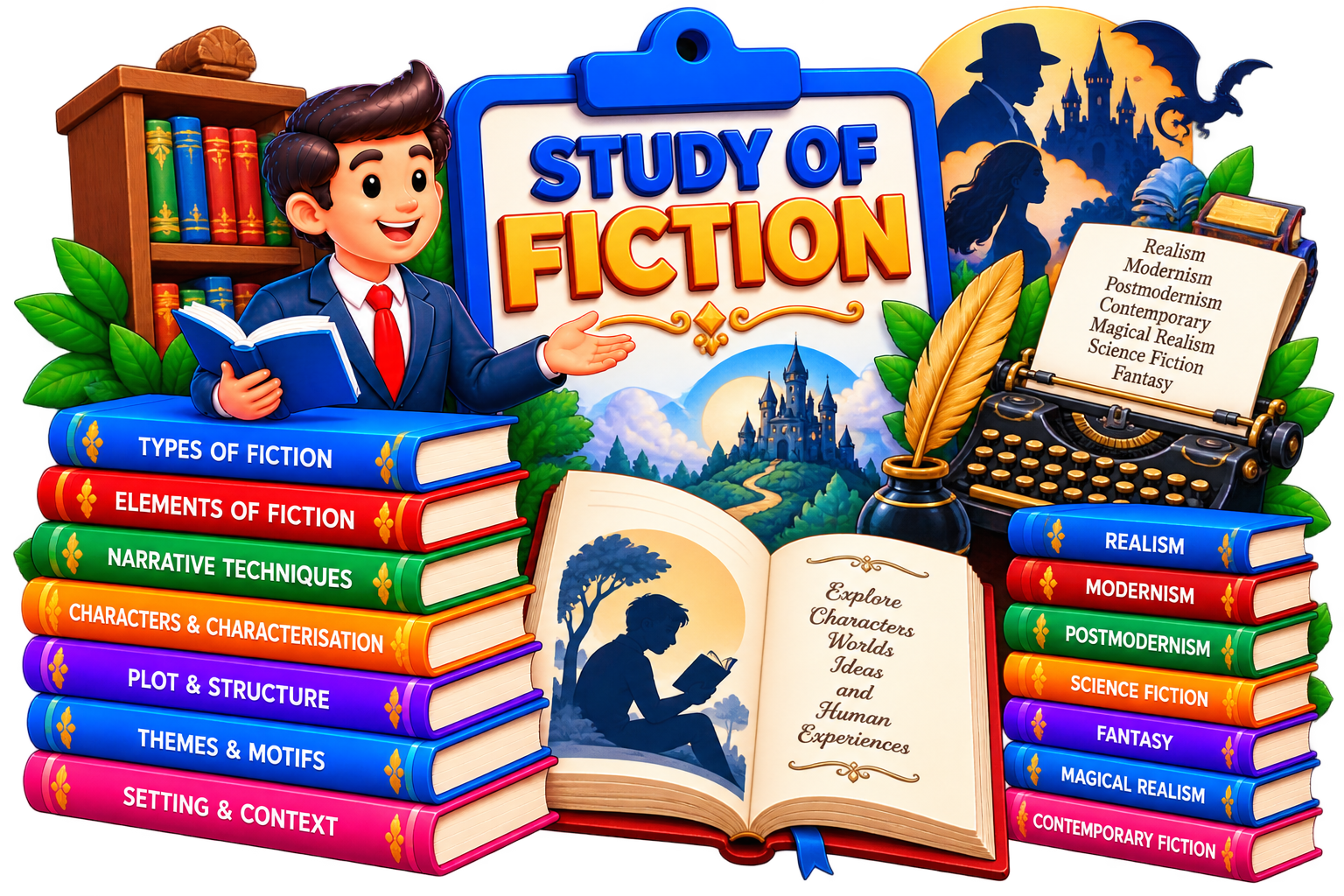
Explore Unit ➜Study of Fiction takes you through the development of the English novel — from the early novels of Defoe, Richardson and Austen, through Victorian realism, to modern experiments in stream of consciousness and dystopia, and finally the worlds of detective and science fiction.



Each unit contains curated notes, summaries, important questions and more.
Fiction and its types — elements of the novel, the Augustan Age, the Age of Enlightenment and trends in eighteenth-century fiction.
Explore Unit ➜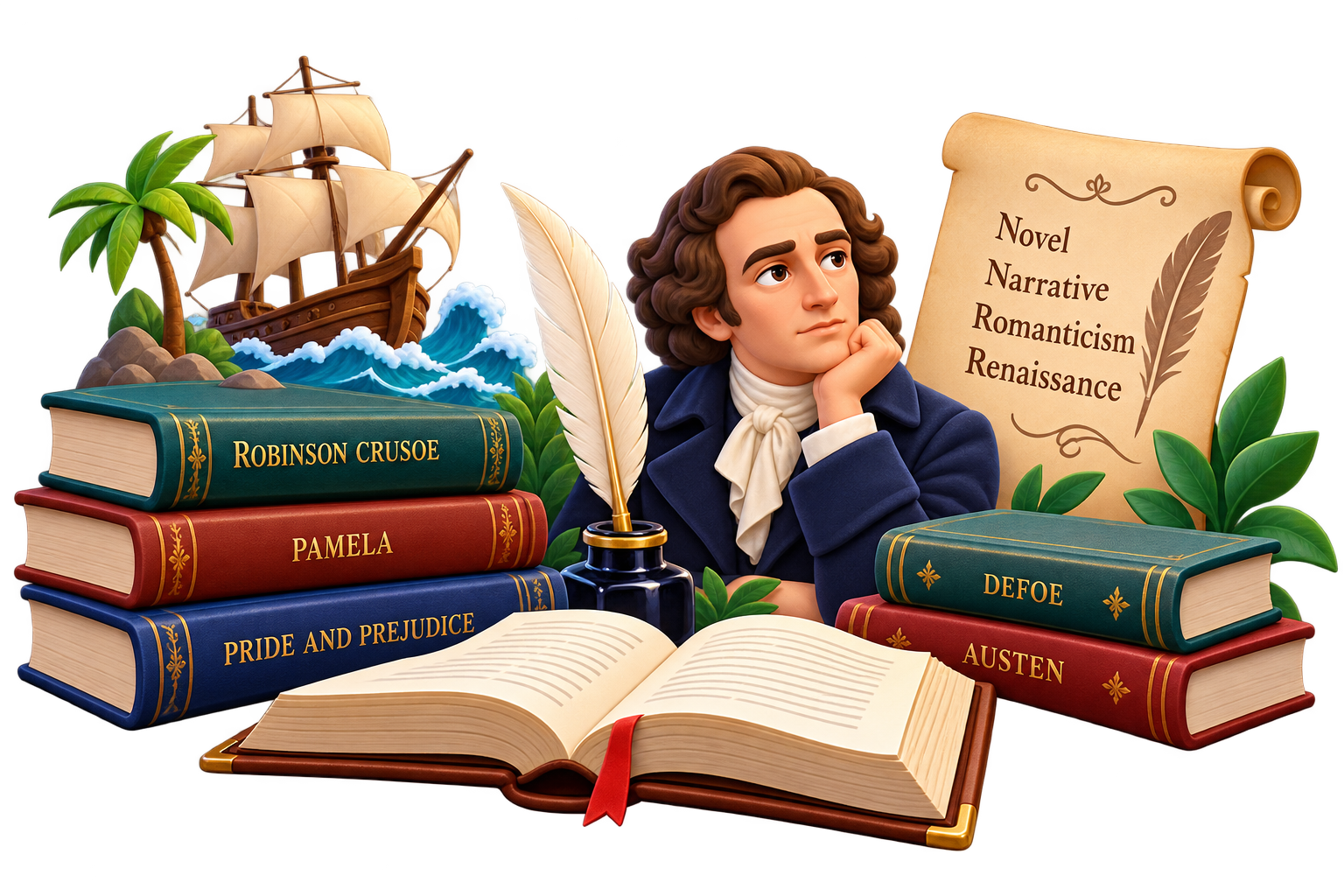
Daniel Defoe's Robinson Crusoe, Samuel Richardson's Pamela and Jane Austen's Pride and Prejudice — impact of the Renaissance, epistolary novel, narrative technique, picaresque novel, Romanticism and the French Revolution.
Explore Unit ➜
Charles Dickens's A Tale of Two Cities, Thomas Hardy's The Mayor of Casterbridge and George Eliot's Middlemarch — Victorian Age, realism, pessimism, fate and destiny, regional, social and tragic novel, Industrial Revolution, rationalism, feminism, materialism and historic fiction.
Explore Unit ➜
D. H. Lawrence's Sons and Lovers, Virginia Woolf's Mrs. Dalloway and George Orwell's 1984 — the Modern Age, autobiographical novel, dystopia, stream of consciousness, Oedipus and Electra complex, symbolism, absurdism, identity and existential crisis, totalitarianism and psychological realism.
Explore Unit ➜
Mary Shelley's Frankenstein, R. L. Stevenson's Dr. Jekyll and Mr. Hyde and Arthur Conan Doyle's The Hound of the Baskervilles — mystery, scientific discovery, Sherlock Holmes, parallel universes, Gothic and science fiction.
Explore Unit ➜
“Read the story,
understand
the world.”
A complete study resource built around the DAVV BA exam pattern.
These Study of Fiction notes for BA DAVV follow the official syllabus of Devi Ahilya Vishwavidyalaya, Indore, unit by unit. From the forms of early fiction in Unit 1 to detective literature and science fiction in Unit 5, every novel is explained in simple language so you can understand the themes and context, not just memorize summaries.
Build a strong foundation with our Unit 1 notes on fiction and its types, the elements of the novel, the Augustan Age, the Age of Enlightenment and trends in eighteenth-century fiction.
Get a strong grip on the early English novel with notes on Robinson Crusoe, Pamela and Pride and Prejudice — the epistolary novel, picaresque novel, narrative technique, Romanticism and the impact of the French Revolution.
Struggling with the big Victorian novels? Our Unit 3 notes break down A Tale of Two Cities, The Mayor of Casterbridge and Middlemarch, with clear explanations of realism, fate and destiny, the social and regional novel, and the Industrial Revolution.
Understand modern experiments in the novel through our notes on Sons and Lovers, Mrs. Dalloway and 1984 — stream of consciousness, the Oedipus complex, dystopia, totalitarianism, symbolism and psychological realism.
Go beyond textbook basics with notes on Frankenstein, Dr. Jekyll and Mr. Hyde and The Hound of the Baskervilles, exploring mystery, scientific discovery, Sherlock Holmes, Gothic fiction and science fiction.
Every unit includes Study of Fiction important questions commonly asked in DAVV BA exams, so you can revise efficiently in the final days before your exam without missing high-weightage topics.
Quick answers about Study of Fiction notes for BA DAVV students.
The DAVV BA Study of Fiction syllabus is divided into 5 units (60 lectures in total, 12 per unit): Forms of Early Fiction, Early Fiction, Victorian Fiction, Modern Fiction, and Detective Literature and Science-fiction.
Yes, all Study of Fiction notes for BA DAVV are completely free to read on CampusNotes directly on the website — no login, signup, or payment required.
There are 5 units in DAVV BA Study of Fiction, each with 12 lectures.
Unit 3 covers A Tale of Two Cities by Charles Dickens, The Mayor of Casterbridge by Thomas Hardy, and Middlemarch by George Eliot.
Yes, CampusNotes is fully mobile-friendly, so you can study Study of Fiction notes on any device without downloading anything.